
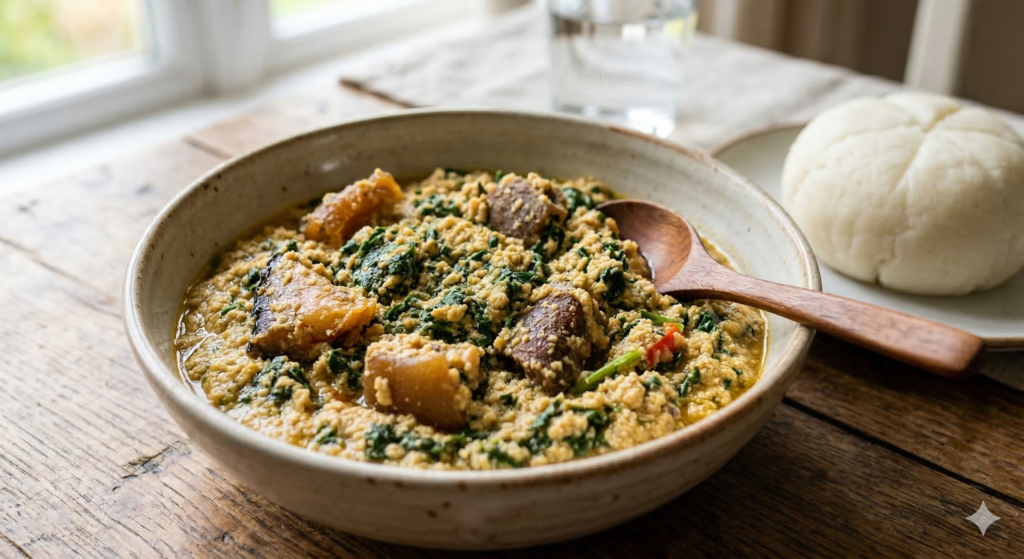
Today we are addressing a significant challenge in Nigerian cuisine: creating a structurally perfect and flavor-dense Egusi soup without adding a single drop of palm oil. The prevailing myth is that “oil-free” Egusi is watery, dull, and lacks those critical, distinct lumps. As your Risk Manager, I am here to dismantle that myth. The fats are already inside the melon seed; our entire strategy is to extract them naturally and use a precise steaming technique to achieve perfection, not porridge. In this guide, you’ll learn how to make oil free Egusi soup that defies expectations.
Egusi soup is a cornerstone of Nigerian hospitality, traditionally served with “Swallows” (like Pounded Yam, Eba, or Amala). This oil-free version has a cleaner, deeply savory, and intensely nutty flavor profile, allowing the natural sweetness of the melon seeds and the complexity of your proteins to shine without being masked by palm oil.
“The Strategy for Success”
How to Make Oil Free Egusi Soup: A Culinary Adventure
The Goal (The Promise): This guide guarantees an oil-free Egusi soup that is rich, thick, and characterized by firm, discrete “clouds” of Egusi, providing a textural eating experience that is indistinguishable (and many say superior) to a traditional palm-oil-fried version. We will rely entirely on the synergistic combination of intrinsic seed fats and layered umami sources to create profound flavor depth. Follow these steps on how to make oil free Egusi soup for a delicious outcome.
The Common Pitfall (The Risk): We have all seen (or cooked) the failed “melon porridge.” This occurs when the soup is watery and thin, lacking all complexity, and the Egusi has dissolved completely, turning the dish into a smooth, unappetizing slurry with zero structural definition.
The Method (The Teacher): The key lies in the “Coagulation and Steaming” method. Instead of frying the ground seeds (which is impossible without oil), we will form a dense, hydrated paste. We will build a highly concentrated, flavor-packed stock, bring it to a rolling simmer, and drop scoops of the paste in. By covering the pot and strictly forbidding stirring, we rely on gentle, indirect heat (steam) to coagulate the Egusi proteins, creating firm, distinct lumps that lock in flavor.
“At a Glance”
| Prep | Cook | Total | Servings | Skill Level |
| 15 mins | 35 mins | 50 mins | 4-6 | Intermediate |
“Why This Recipe Works”
- Protein Coagulation: Melon seeds are high in protein. By steaming the dense Egusi paste inside the stock without mechanical agitation (stirring), the heat causes the proteins to denature and bind together tightly, creating those highly sought-after firm lumps.
- Intrinsic Fats: Ground Egusi is naturally 50-60% fat (oil). By boiling the ground seeds for a sufficient time, we naturally release this “oil-in-the-seed” into the soup base, providing all the critical richness and mouthfeel we require, without adding exogenous oil.
- Layered Umami: Flavor development does not come from oil; it comes from technique and quality ingredients. We will layer deep savory notes (glutamates) from a rich stock, stockfish, and coarse crayfish, creating a profound flavor matrix that requires no palm oil to “boost” it.
“The Ingredients (Teacher’s Notes)”
- Ground Egusi (Melon Seeds): 2 Cups (approx. 240g).
- 💡 (The Teacher’s ‘Why’): Primary source of protein, fat (mouthfeel), and core nutty flavor. The core builder and only fat source in the soup. Its protein allows for the essential coagulation structure.
- 🚫 (The Risk Manager’s ‘Why Not’): DO NOT buy pre-ground Egusi from unknown sources; it oxidizes quickly, smells rancid, and turns gray. Buy whole seeds, ensure they look fresh and bright, and smell neutral. Grind them yourself right before cooking for maximum flavor and binding power.
- Coarsely Ground Crayfish: 1/2 Cup (approx. 60g).
- 💡 (The Teacher’s ‘Why’): The indispensable sea-salt and umami component. Acts as a natural flavor enhancer, bridging the land and sea flavors while providing complexity. Coarse grind adds essential texture.
- 🚫 (The Risk Manager’s ‘Why Not’): DO NOT use gritty, dirty crayfish or pre-ground “dust.” This adds grit and a muddy, dull flavor. Buy clean, whole crayfish from a reputable vendor and grind them yourself.
- Protein Base (e.g., Stockfish and Dry Fish): Pre-soaked and washed stockfish head (1 medium) and pre-soaked dry fish (e.g., Catfish or cod, 1 piece).
- 💡 (The Teacher’s ‘Why’): Stockfish and dry fish are powerful umami generators. Their deep, concentrated glutamates are essential for providing complexity to a dish that lacks palm oil.
- 🚫 (The Risk Manager’s ‘Why Not’): DO NOT skip pre-soaking and proper washing. If you skip this, your soup will retain sand or dirt, and the intense pungent smell (in a bad way) will dominate the delicate melon seed flavor.
(Other Essential Ingredients):
- 2 lbs (900g) assorted protein (e.g., pre-cooked beef, goat, offal, and the pre-soaked stockfish/dry fish).
- Teacher’s Note: Use high-quality bones/assorted meats to create a rich stock. Do not discard the cook-water!
- 1 large red bell pepper (tatashe), 1 large onion, 2-3 scotch bonnet peppers (Ata Rodo) to your heat preference, and 1 medium tomato. (Aromatic Pepper Mix).
- 4 Cups (960ml) rich protein stock.
- 2-3 bouillon cubes (or equivalent seasoning).
- 1 Cup (approx. 240g) finely chopped Ugu (Fluted Pumpkin) or Spinach.
- Salt to taste.
“Instructions (The ‘Why/Why Not’ Core)”
Phase 1: Prep and Building the Aromatic Base
The Step: Create the Aromatic Pepper Mix and Coarse Crayfish. Blend the red bell pepper, onion, scotch bonnets, and tomato with as little water as possible until relatively smooth. Separately, grind your crayfish (buy whole and clean) until coarsely ground (not a fine powder).
💡 (The Teacher’s ‘Why’): Using minimal water for the pepper mix keeps the flavors concentrated. A coarse grind on the crayfish ensures they retain some textural identity and do not simply dissolve, adding complex bursts of flavor.
🚫 (The Risk Manager’s ‘Why Not’): Dilute the pepper mix with excessive water now, and your final soup will be watery and weak. We are not frying this mix, so its original water content determines the initial concentration of the soup base.
Phase 2: Establish the Coagulation Environment
The Step: Simmer the Umami-Pepper Stock. In a large pot, combine the rich protein stock (ensure it is highly concentrated), the blended pepper mix, pre-soaked stockfish, dry fish, pre-cooked beef/assorted protein, bouillon cubes, half of the coarse crayfish, and salt to taste. Bring to a boil, then reduce heat and simmer covered for 10-15 minutes, allowing the flavors to fuse and the stockfish glutamates to deeply season the stock. Ensure you have about 4 cups of liquid; the soup should be flavorful but relatively thin.
💡 (The Teacher’s ‘Why’): This establishes a rolling-simmer environment required for rapid protein denaturation (coagulation). By simmering now with umami sources (crayfish/dry fish/stockfish), we infuse the very environment the Egusi will steam in, ensuring every lump is flavor-dense.
🚫 (The Risk Manager’s ‘Why Not’): DO NOT drop Egusi into cold water or plain stock. We need a concentrated, flavor-fusion broth that is already simmering. If you skip this fuse time, your lumps will form, but they will be structurally sound yet flavorless.
Phase 3: The Binding Paste (The Lumps Method)
The Step: Create the Coagulation Paste. While the stock simmers, place your freshly ground whole Egusi in a clean bowl. Gradually add either a few spoonfuls of cool stock (or cool water), mixing constantly until you form a thick, very dense paste. Think “play-dough consistency,” not a slurry.
🚫 Explicit Warning: “Add liquid sparingly. We want a dense paste, not a slurry.”
💡 (The Teacher’s ‘Why’): High-density Egusi paste allows the ground melon seeds to be physically closer together. Water helps physically bind the ground particles initially, but adding too much water keeps them too far apart for tight coagulation. A dense paste ensures rapid and strong protein-protein bonds are formed when heat is applied, creating firm lumps.
🚫 (The Risk Manager’s ‘Why Not’): Create a runny batter or slurry, and the Egusi particles will simply disperse into the stock upon contact. This will physically prevent coagulation, giving you a melon porridge with no lumps. Oxidation will also likely proceed rapidly, turning your soup a sad gray color.
Phase 4: Steam-Coagulate the Egusi (Set the Proteins)
The Step: The “Drop and Cover” Method (Strict NO STIRRING). To the simmering stock, add the remaining half of your coarse crayfish. Now, take scoops of your dense Egusi paste and gently drop them into the simmering stock. They should sink slightly, then float as they heat. Continue until all paste is added. Crucial: Gently press down any floating scoops to ensure they are submerged, but DO NOT STIR. Cover the pot immediately with a tight-fitting lid, reduce heat slightly to maintain a gentle, rolling simmer, and LEAVE UNTOUCHED FOR 10-15 MINUTES.
🚫 Explicit Warning: “DO NOT STIR. Put the spoon down and walk away for 10 minutes.”
💡 (The Teacher’s ‘Why’): This is the critical moment. Mechanical agitation (stirring) at this stage will physically break the fragile, developing protein bonds before they can set firm. By covering the pot, we are relying on gentle, indirect heat from the simmering stock and steam to cook and coagulate the Egusi proteins, setting the lumps from the outside in. We are creating discrete flavor clouds.
🚫 (The Risk Manager’s ‘Why Not’): Stir wildly or frequently now, and you immediately break the developing protein structures. The paste will dissolve instantly, and you will have melon porridge. This is the #1 point of failure for beginners, almost always driven by anxiety over “the lumps melting.” They will not melt if left alone. Put the spoon down.
Phase 5: Consolidation and Adding Greens
The Step: Break and Simmer to Release Fats, then Finish with Greens. After 10-15 minutes, uncover the pot. The Egusi scoops should be firm to the touch (like steamed clouds). Now, and only now, you can gently use your spoon to break up some of the larger lumps into your preferred “lumpy” size. Ensure the Egusi is cooked through (simmer uncovered for 5-10 minutes more; the Egusi should release its natural nutty fat, which will appear as a slightly lighter layer on top). Add your finely chopped Ugu (or spinach), stir gently just to combine, and cook uncovered for only 2-3 more minutes. Turn off the heat.
💡 (The Teacher’s ‘Why’): We simmer further to release the seed’s fats and ensure the Egusi is fully cooked (raw Egusi can cause stomach upset). Greens are added last to retain color, texture, and volatile nutrients, preventing them from turning brown and bitter.
🚫 (The Risk Manager’s ‘Why Not’): Boil greens for 10 minutes, and they will become a brown, nutrient-poor mush, ruining the entire aesthetic and nutritional profile of the soup. Do not skip the uncovered simmer after uncovering; this releases the natural fats.
“The ‘Risk-Free Q&A’ (Troubleshooting)”
Scenario 1: “Help! My soup turned into porridge. No lumps!”
- Analysis: Two potential causes: Either the Egusi paste was too runny (making a slurry), or you stirred the soup before the Egusi proteins had time to coagulate and set firm. Mechanical agitation breaks fragile bonds.
- Solution: Unfortunately, once dissolved, you cannot create lumps. Re-title it “Melon Porridge” and enjoy (the taste will still be good!). To prevent this next time: ensure your paste is very dense (like play-dough) and do not touch with a spoon during the 10-minute simmering phase.
Scenario 2: “The soup tastes watery/thin, despite adding bouillon.”
- Analysis: Flavor development depends on building a rich, deeply concentrated stock. You likely over-diluted your stock water-to-protein ratio. In an oil-free soup, we rely 100% on stock concentration for depth and mouthfeel.
- Solution: Simmer the soup uncovered for 5-10 minutes without greens to reduce the liquid and concentrate the flavor. For the next batch, use high-quality assorted meats/stockfish and prioritize concentrated umami sources rather than watery stock.
Scenario 3: “The Egusi smells or tastes ‘off’ or rancid.”
- Analysis: The raw Egusi melon seeds you used were already bad (oxidized). Oxidation creates rancidity, giving a powerful “gray, dusty, off-putting” flavor profile that bouillon cannot mask.
- Solution: Unfortunately, this ruins the entire batch. Discard it. For future batches, always buy whole seeds, smell them first (they must smell neutral or fresh/nutty), and grind them yourself or right before cooking. Avoid pre-ground seeds from unknown sources.
Notes & Substitutions
- Greens: Finely chopped Ugu (Fluted Pumpkin) is traditional. Spinach is an excellent substitution; waterleaf can also work, but use very sparingly as it adds water. Scent leaves (Efirin) add a powerful aroma.
- Proteins: Beef, goat, offal (shaki), dry fish, and stockfish are best. Do not use fresh fish unless it is pre-grilled/smoked to prevent it from breaking into the Egusi during consolidation.
Make-Ahead & Storage
Egusi soup is even better the next day as the flavors continue to develop. Refrigerate for up to 3 days or freeze for up to 2 months. Thaw completely before gently reheating on the stove. Lumps hold up well in the freezer.
The “Best” [OIL FREE EGUSI SOUP] Recipe Card
Ingredients
- Assorted Protein: Beef/goat/stockfish/dry fish (pre-cooked/soaked), about 2 lbs (900g).
- Egusi: Whole melon seeds, ground, 2 Cups (240g).
- Aromatics (Pepper Mix): Red bell pepper, onion, 2 scotch bonnets, 1 tomato.
- Umami: Crayfish (coarsely ground), 1/2 Cup (60g).
- Stock: 4 Cups (960ml).
- Seasoning: 2-3 bouillon cubes, salt to taste.
- Greens: Finely chopped Ugu or Spinach, 1 Cup (240g).
Instructions
- Prep: Blend peppers/onion/tomato into a thick paste with minimal water. Grind clean crayfish coarsely.
- Fusion Stock: Combine rich stock, pepper mix, cooked/pre-soaked assorted proteins, stockfish, dry fish, and half of the crayfish. Season with bouillon and salt. Simmer covered for 10-15 minutes.
- Coagulation Paste: Gradually add drops of cool stock or water to the ground Egusi, mixing constantly to form a very thick, dense paste.
- Drop & Cover: Scoop scoops of Egusi paste and drop gently into the simmering stock. Press scoops submerged, then cover pot tightly. Do NOT stir. Maintain rolling simmer, untouched, for 10-15 minutes until set.
- Finish: Uncover; break Egusi scoops to preferred size. Simmer gently uncovered (5-10 mins) until Egusi releases its fats. Add Ugu/greens, stir just to combine, and cook uncovered for only 2-3 minutes. Turn off heat and serve.
If you are here because you love Egusi soup and would like to learn how to make it the traditional way then go here for our traditional Egusi soup recipe: https://bestnigerianrecipes.com/recipes/egusi-soup/