
2. Intro
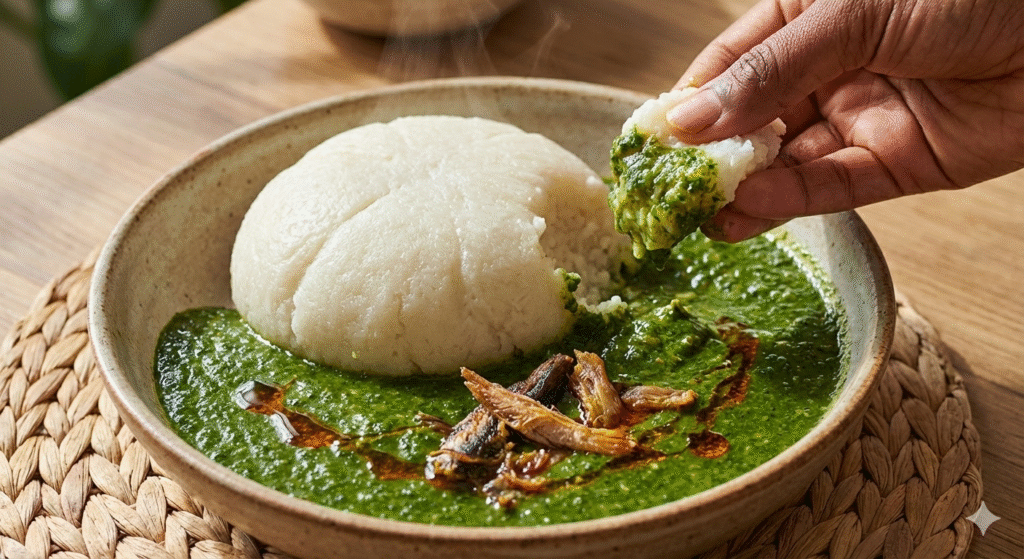
Tuwo Shinkafa is a Northern Nigerian staple, a soft, sticky “swallow” (fufu) made from non-parboiled white rice. Unlike the pounded yam of the South which is elastic and heavy, Tuwo Shinkafa is delicate, slightly sweet, and cloud-like. It is the traditional accompaniment to soups like Miyan Kuka (Baobab leaf soup) or Miyan Taushe (Pumpkin soup). It serves as a neutral canvas, soaking up the rich flavors of the soup without fighting for attention. I did my national youth service in the northern part of Nigeria and this was one of my favorite staples.
3. Section: “The Strategy for Success”
- The Goal (The Promise): We are aiming for a pristine white mound that is perfectly smooth—no individual rice grains should be visible. It should be soft enough to cut with your fingers but firm enough to hold a scoop of soup without disintegrating.
- The Common Pitfall (The Risk): The most common failure is “The Porridge Effect.” This happens when the rice is cooked too loose and cannot be molded, or conversely, “The Gritty Tuwo,” where the cook uses the wrong rice variety, resulting in hard grains that refuse to mash smooth.
- The Method (The Teacher): We will use the “Over-Hydration & Mash” Technique. Unlike cooking rice for Jollof (where we want separate grains), here we intentionally overcook the rice in excess water to break down the cellular structure, followed by vigorous mechanical mashing to release the starch (amylopectin) that binds it all together.
4. Table: “At a Glance”
| Prep | Cook | Total | Servings | Skill Level |
| 10 Mins | 45 Mins | 55 Mins | 4 | Intermediate |
5. Section: “Why This Recipe Works”
- Specific Starch Selection: By using short-grain, non-parboiled rice, we maximize amylopectin (sticky starch) and minimize amylose (fluffy starch). This chemistry ensures the Tuwo binds naturally without needing added flour.
- Hydration Ratios: We use a higher water-to-rice ratio (approx. 2.5:1) than standard cooking. This allows the rice kernels to burst completely, making the mashing process effortless.
- Resting Phase: Allowing the Tuwo to sit wrapped in plastic for 5 minutes before serving allows the starch network to “set” or retrograde slightly, giving it that perfect firm-yet-soft texture.
6. Section: “The Ingredients (Teacher’s Notes)”
- Short-Grain “Tuwo” Rice: 2 Cups (raw).
- 💡 (The Teacher’s ‘Why’): You need a rice variety that gets sticky when cooked. In Nigerian markets, ask for “Tuwo Rice.” In international markets, “Sushi Rice” or “Paella Rice” (Arborio) are the closest chemical matches.
- 🚫 (The Risk Manager’s ‘Why Not’): DO NOT use Parboiled Rice, Basmati, or Long Grain Rice. They have been processed to stay separate. If you use them, you will mash until your arm falls off, and it will still be lumpy and grainy.
- Water: 5 to 6 Cups (Keep extra hot water on standby).
- 💡 (The Teacher’s ‘Why’): Water acts as the solvent to gelatinize the starch granules.
- 🚫 (The Risk Manager’s ‘Why Not’): Do not start with cold water if topping up the pot later. Always add boiling water to maintain the cooking temperature; cold water will shock the starch and make the cooking uneven.
7. Section: “Instructions (The ‘Why/Why Not’ Core)”
Phase 1: The Rinse
The Step: Rinse the rice in cool water only once or twice.
- 💡 (The Teacher’s ‘Why’): For Jollof, we wash until clear to remove surface starch. For Tuwo, we want that surface starch. It helps the binding process.
- 🚫 (The Risk Manager’s ‘Why Not’): Do not scrub the rice aggressively. You are washing away the “glue” that holds your Tuwo together.
Phase 2: The Over-Boil
The Step: Place rice in a pot with 5 cups of water. Bring to a boil, then reduce heat to low-medium. Cover and cook undisturbed until the water is absorbed and the rice is effectively “mushy” and very soft. (Approx. 25-30 mins).
- 💡 (The Teacher’s ‘Why’): We are breaking down the cell walls of the rice grain. If you taste a grain, it should offer zero resistance.
- 🚫 (The Risk Manager’s ‘Why Not’): Do not let the pot burn at the bottom. Burnt rice will put black specks in your pristine white Tuwo and introduce a bitter charcoal flavor.
Phase 3: The Mash (The Workout)
The Step: Once the water is dried and rice is super soft, remove from heat slightly. Using a wooden spatula (Omorogun), mash the rice against the sides of the pot. Use a folding and spreading motion.
- 💡 (The Teacher’s ‘Why’): This mechanical action aligns the starch molecules. You are transforming “cooked rice” into a “dough.”
- 🚫 (The Risk Manager’s ‘Why Not’): Do not wait for the rice to cool down. Starch retrogrades (hardens) as it cools. You must mash while it is piping hot to get a smooth texture.
Phase 4: The Steam Finish
The Step: Once mashed, gather the dough into the center of the pot. Add 2 tablespoons of hot water around the edges, cover, and steam on very low heat for 2 minutes. Mash one final time to incorporate the water.
- 💡 (The Teacher’s ‘Why’): This final steam ensures the dough is glossy and fully hydrated.
- 🚫 (The Risk Manager’s ‘Why Not’): Do not skip this if your Tuwo looks dry or stiff. This step relaxes the dough.
8. Section: “The ‘Risk-Free Q&A’ (Troubleshooting)”
- Analysis 1: “Help! It’s too soft and runny!”
- The Diagnosis: You used too much water, or the rice quality was different.
- The Solution: Do not panic. Sprinkle a little Rice Flour (or even cornstarch slurry) into the pot and stir vigorously over low heat. It will thicken up immediately.
- Analysis 2: “It’s lumpy and I can see whole grains.”
- The Diagnosis: You used the wrong rice (parboiled/long grain) or you didn’t cook it soft enough before mashing.
- The Solution: The “Cheat Code”: Transfer the mix to a blender or food processor. Pulse it a few times until smooth, then return to the pot to warm through. (Don’t tell Grandma).
- Analysis 3: “It formed a hard crust while cooling.”
- The Diagnosis: Exposure to air causes the surface starch to dry out instantly.
- The Solution: Always wrap Tuwo in plastic film (cling film) immediately after serving/shaping to keep it moist.
9. Section: Notes & Substitutions
- Rice Flour Method: You can also make Tuwo Shinkafa using store-bought Rice Flour (powder). It is faster (like making Semo), but the texture is often “gummy” compared to the “whole grain mashed” method described here.
- Leftovers: Tuwo hardens significantly in the fridge. To reheat, sprinkle with water and microwave, or steam it.
10. Section: Make-Ahead & Storage
- Short Term: Wrap individual portions in plastic wrap and keep in an insulated cooler/warmer until dinner is served.
- Freezing: You can freeze the wrapped portions. Thaw fully before reheating in a microwave with a splash of water.
11. Section: The “Best” Tuwo Shinkafa Recipe Card
Ingredients:
- 2 cups Short-Grain Rice (Tuwo Rice/Sushi Rice)
- 5-6 cups Water (divided)
- Plastic wrap (for shaping)
Instructions:
- Wash: Rinse rice lightly (leave some starch).
- Boil: Combine rice and 5 cups water in a pot. Cook on medium-low until rice is over-soft and water is absorbed (approx. 30 mins).
- Check: Test a grain. It should crush instantly between fingers. If hard, add ½ cup hot water and cook longer.
- Mash: Using a wooden spoon, mash the rice vigorously against the pot sides until grains disappear and a dough forms.
- Steam: Add a splash of water, cover, and steam on low for 2 mins.
- Shape: Scoop onto a sheet of plastic wrap, fold the plastic over to shape into a smooth ball, and serve warm with soup.