
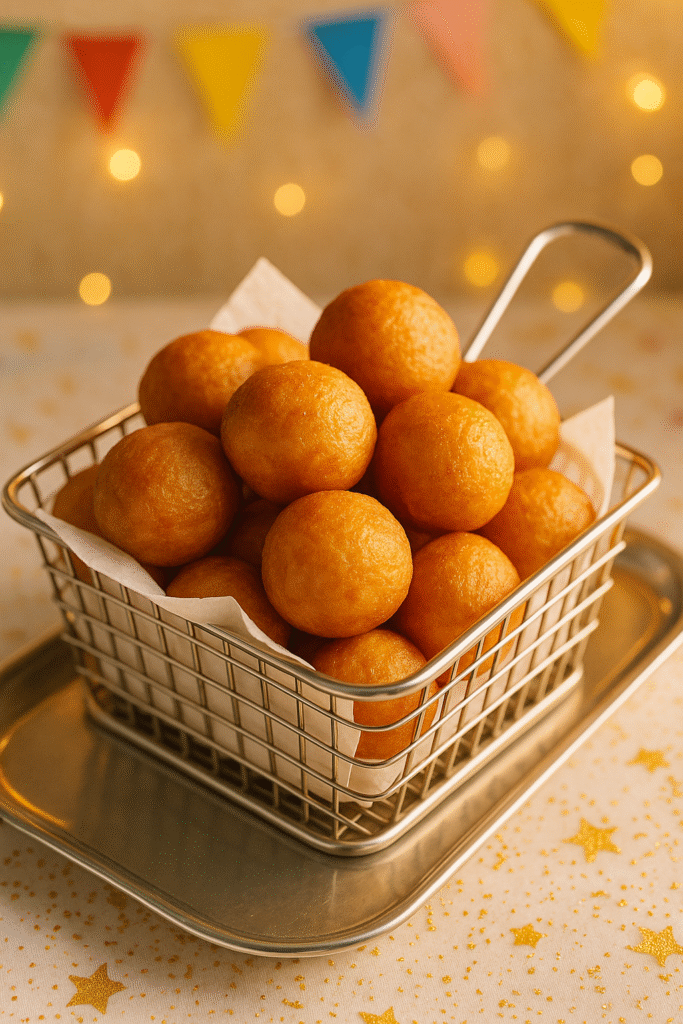
Puff-Puff: The “Perfect Sphere” Fermentation Method
Puff Puff is a quintessential Nigerian street snack and party staple (“Small Chops”). These are deep-fried dough balls that are golden and slightly crisp on the outside, with a sponge-like, airy, and chewy interior.
When to serve: As an appetizer/snack at gatherings, or a breakfast treat. It is my go-to appetizer when I entertain.
Flavor profile: Sweet, yeasty, and warm with a hint of nutmeg.
The Strategy for Success
The Goal (The Promise): This guide ensures you get perfectly round, golden spheres that are pillowy-soft on the inside, without soaking up excess oil or turning into heavy, dense rocks.
The Common Pitfall (The Risk): We’ve all seen Puff-Puff that looks like “amoebas” (weird shapes), is raw in the center, or—worst of all—acts like a sponge, drinking up the oil until it is greasy and unpalatable.
The Method (The Teacher): I will teach you the “Viscosity Check” for the batter and the “Hand-Squeeze” technique for frying. The secret to round puff-puff isn’t a spoon; it’s your hand. We will also strictly manage fermentation to ensure the yeast creates enough air pockets for that signature bounce.
At a Glance
| Prep | Cook | Total | Servings | Skill Level |
| 50 mins | 20 mins | 70 mins | 6 | Intermediate |
Why This Recipe Works
-
The Yeast “Bloom”: We prove the yeast is alive before mixing. This prevents the tragedy of wasting flour on a batch that will never rise.
-
Gluten Development: We beat the batter vigorously. This develops gluten strands which trap the carbon dioxide bubbles, creating the chewy, sponge-like texture rather than a cake-like crumb.
-
Temperature Equilibrium: We maintain a specific oil temperature range. If too hot, the outside burns before the inside cooks; if too cold, the dough absorbs oil.
The Ingredients (Teacher’s Notes)
-
All-Purpose Flour (Plain Flour): 2.5 cups (approx. 315g)
-
💡 (The Teacher’s ‘Why’): This flour has the right protein content (10-12%) to form a structure that holds shape but remains soft.
-
🚫 (The Risk Manager’s ‘Why Not’): Do not use Cake Flour (too weak, will collapse) or Bread Flour (too tough/chewy for a snack). Do not use Self-Rising flour as we need to control the yeast manually.
-
-
Instant Yeast (or Active Dry): 2 teaspoons
-
💡 (The Teacher’s ‘Why’): This is the engine. It eats the sugar and releases gas (CO2), which puffs up the dough.
-
🚫 (The Risk Manager’s ‘Why Not’): Check the expiration date. If your yeast is dead, you are making fried stones. If using Active Dry, you must bloom it in water first.
-
-
Sugar: 1/2 cup (100g)
-
💡 (The Teacher’s ‘Why’): Feeds the yeast and provides the signature sweetness and golden browning (caramelization).
-
🚫 (The Risk Manager’s ‘Why Not’): Do not reduce this too much, or the yeast will starve and the browning will be pale.
-
-
Warm Water: 1.5 cups (350ml) – Adjustable
-
💡 (The Teacher’s ‘Why’): Warmth accelerates fermentation.
-
🚫 (The Risk Manager’s ‘Why Not’): CRITICAL: The water must be “baby bath” warm (approx. 100°F-110°F). If the water is boiling/hot, you will kill the yeast instantly. If it is ice cold, the dough won’t rise.
-
-
Nutmeg: 1/2 teaspoon (Ground)
-
💡 (The Teacher’s ‘Why’): This gives Nigerian Puff-Puff its distinct, nostalgic aroma.
-
-
Salt: 1/2 teaspoon
-
💡 (The Teacher’s ‘Why’): Controls the yeast so it doesn’t go crazy, and balances the sweetness.
-
-
Vegetable Oil: For deep frying (at least 3 inches deep)
Instructions (The “Why/Why Not” Core)
Step 1: The Yeast Audit (Blooming)
The Step: In a large bowl, combine the warm water, 1 tablespoon of the sugar, and the yeast. Stir and let it sit for 5-7 minutes until it becomes frothy/foamy. (If using Instant Yeast, you can skip this, but I recommend doing it anyway to ensure the yeast is alive).
-
💡 (The Teacher’s ‘Why’): We are waking up the yeast organisms with a warm bath and a snack (sugar). The foam proves they are active.
-
🚫 (The Risk Manager’s ‘Why Not’): If after 10 minutes there is zero foam, STOP. Do not proceed. Your yeast is dead or your water was too hot. Throw it out and buy new yeast. If you continue, you will waste your flour.
Step 2: The Batter Construction
The Step: In a separate bowl, mix flour, remaining sugar, nutmeg, and salt. Add the wet yeast mixture to the dry ingredients. Mix thoroughly with your hand or a wooden spoon. Beat the batter by lifting it and slapping it against the bowl for 2-3 minutes until smooth and stretchy.
-
💡 (The Teacher’s ‘Why’): That slapping motion develops gluten. We want the batter to be “stretchy” so it can expand without bursting.
-
🚫 (The Risk Manager’s ‘Why Not’): Do not just gently mix until combined. If you don’t develop the gluten, the puff-puff will have large, uneven holes or soak up oil.
Step 3: The Rise (Fermentation)
The Step: Cover the bowl with plastic wrap or a clean kitchen towel. Place it in a warm, draft-free spot (like inside a turned-off microwave or oven). Let it rise for 45 minutes to 1 hour. The size should double, and you should see many bubbles.
-
💡 (The Teacher’s ‘Why’): The yeast is producing gas. The flavor is also developing during this time.
-
🚫 (The Risk Manager’s ‘Why Not’): Do not let it over-proof (rise for 2+ hours). If it rises too much, the gluten structure will weaken, and the puff-puff will collapse when it hits the hot oil, turning flat and oily.
Step 4: The “Squeeze” Frying Technique
The Step: Heat your oil to 350°F (175°C). Test with a tiny drop of batter—it should sizzle and float up immediately.
The Technique: Grab a handful of batter. Make a fist. Squeeze the batter through the hole formed by your thumb and index finger. As a ball extrudes, use your other hand (or gravity) to drop it into the oil.
-
💡 (The Teacher’s ‘Why’): This extrusion technique forces the batter into a perfect spherical shape due to surface tension.
-
🚫 (The Risk Manager’s ‘Why Not’): Do not drop from a high distance (hot oil splashes!). Do not overcrowd the pan. If you put too many in, the oil temperature drops, and the puff-puff will drink the oil and become soggy.
Step 5: The Roll & Finish
The Step: Fry until the bottom is golden brown. Use a slotted spoon to flip them (or press them down so they rotate). Fry until golden brown on all sides (about 3-5 minutes total). Remove and drain on paper towels.
-
💡 (The Teacher’s ‘Why’): Constant rotation ensures the center cooks through at the same rate as the crust.
-
🚫 (The Risk Manager’s ‘Why Not’): If they brown in 30 seconds, your oil is too hot. The inside will be raw batter. Turn the heat down.
The “Risk-Free Q&A” (Troubleshooting)
-
“Help! My Puff-Puff is soaking up oil and tastes greasy!”
-
Analysis: Your oil was too cold, or you overcrowded the pan, dropping the temperature.
-
Solution: Increase the heat. Fry fewer balls at a time. Use a kitchen thermometer to maintain 170°C-180°C.
-
-
“Help! It’s raw/gooey in the middle but dark brown outside!”
-
Analysis: Your oil is too hot. The outside cooked before the heat could penetrate the center.
-
Solution: Lower the heat immediately. Allow the oil to cool slightly before the next batch.
-
-
“Help! My batter didn’t rise!”
-
Analysis: Dead yeast, or water was too hot/cold.
-
Solution: Unfortunately, you cannot fix this batter. You must start over with fresh yeast.
-
Notes & Substitutions
-
Pepper Puff: Add 1 tablespoon of finely minced Scotch Bonnet and onions to the batter for a spicy savory version.
-
Cinnamon Sugar: Roll the hot puff-puff in cinnamon sugar for a doughnut-style treat.
-
Consistency Check: The batter should be thicker than pancake batter but thinner than bread dough. It should flow slowly like thick honey.
Make-Ahead & Storage
-
Batter: You can make the batter overnight and let it rise slowly in the fridge. Bring to room temperature for 30 mins before frying.
-
Storage: Puff-Puff is best eaten fresh. If stored, keep in an airtight container for 2 days.
-
Reheating: Reheat in an oven or air fryer for 2-3 minutes to crisp them back up. Microwaving makes them rubbery.
The “Best” Puff-Puff Recipe Card
Ingredients:
-
2.5 cups All-Purpose Flour
-
1/2 cup Sugar
-
2 tsp Instant Yeast
-
1/2 tsp Ground Nutmeg
-
1/2 tsp Salt
-
1.5 cups Warm Water (105°F)
-
Vegetable Oil (for frying)
Instructions:
-
Bloom: Mix water, 1 tbsp sugar, and yeast. Wait 5 mins for foam.
-
Mix: Combine flour, sugar, nutmeg, and salt. Pour in yeast liquid.
-
Beat: Mix vigorously by hand/spoon for 2-3 mins to develop gluten.
-
Rise: Cover and place in a warm spot for 45-60 mins until doubled.
-
Heat: Heat oil to 350°F (175°C).
-
Fry: Squeeze batter through thumb/index finger to form balls. Drop into oil.
-
Cook: Fry for 3-5 mins, rotating frequently, until golden brown. Drain and serve.
I