
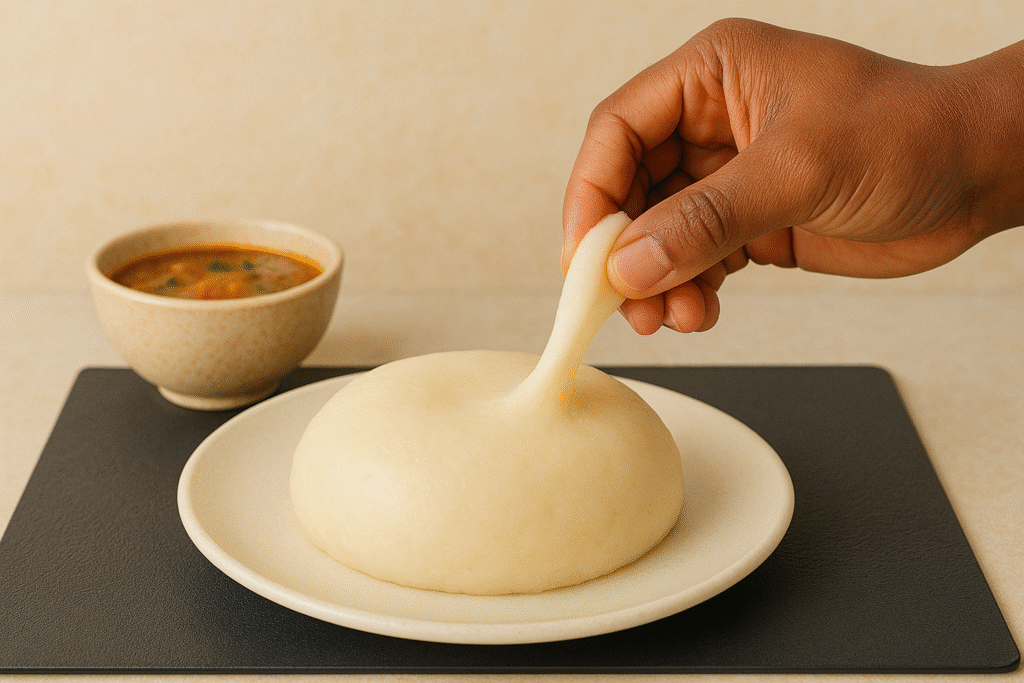
Pounded Yam (Iyan): The “Stretch and Smooth” Technique
Intro
Pounded Yam (Iyan) is arguably the most revered “Swallow” in Nigerian cuisine. It is a smooth, dense, and elastic dough made from boiled white yams, traditionally pounded in a mortar and pestle. Unlike the lighter Eba or the gelatinous Amala, Pounded Yam offers a subtle sweetness and a luxurious mouthfeel. It is the premium partner for rich soups like Egusi, Efo Riro, or Nsala. Growing up my father refused on principle to eat anything made with so much sweat capital, so we never ate pounded Yam until very early on in my adulthood, when I perfected the blender, processor and yam pounder methods.
The Strategy for Success
The Goal (The Promise):
This guide ensures you achieve the “Holy Grail” of Iyan: a mound that is silky smooth (zero lumps), visibly stretchy (elastic), and holds its shape without being rock hard.
The Common Pitfall (The Risk):
The most frequent failure is a texture known as “lumpy gum.” This happens when the yam isn’t cooked through, leading to hard granules (lumps), or when too much water is added during the pounding process, resulting in a sticky, shapeless mess that slides off your fingers.
The Method (The Teacher):
We will use the “Steam-Process-Knead” Method (utilizing a food processor or stand mixer). While the traditional mortar is iconic, this modern method replicates the mechanical action of pounding by breaking the yam down into hot crumbles first, then using high-speed shearing force to align the starch molecules into a cohesive, stretchy dough.
At a Glance
| Prep | Cook | Total | Servings | Skill Level |
| 15 Min | 20 Min | 35 Min | 2-3 | Intermediate |
Why This Recipe Works
- Starch Density Selection: By strictly using “Old Puna Yam,” we ensure high amylose content. This starch is the structural backbone that allows the yam to be pounded into a dough rather than turning into mashed potatoes.
- Thermal Momentum: We process the yam immediately while it is piping hot. Starch molecules are most malleable and willing to bond when fully gelatinized and hot; waiting even 5 minutes allows retrogradation (hardening) to set in, causing lumps.
- Controlled Hydration: Instead of boiling the yam in excess water that waterlogs the vegetable, we steam-boil it. This keeps the yam dry enough to accept controlled water addition during the pounding phase, giving you total control over softness.
The Ingredients (Teacher’s Notes)
- 1 kg White Puna Yam (Dioscorea rotundata)
- 💡 (The Teacher’s ‘Why’): You specifically need “Old Yam” (harvested last season). It has low moisture and high starch density. This creates the signature stretch.
- 🚫 (The Risk Manager’s ‘Why Not’): Do not use “New Yam” (fresh harvest). It has high water content and sugar; it will turn into a runny, sticky paste that cannot be molded. Do not use American Sweet Potatoes or Irish Potatoes.
- 1/2 Cup Hot Water (Reserved from boiling)
- 💡 (The Teacher’s ‘Why’): Using the starch-rich water from the pot helps bind the yam. It must be hot to maintain the temperature of the dough.
- 🚫 (The Risk Manager’s ‘Why Not’): Do not use cold tap water. Cold water shocks the hot starch, causing it to seize up and creating immediate lumps.
Instructions (The ‘Why/Why Not’ Core)
Step 1: Precise Prep and Cutting
Peel the yam and cut it into small, uniform cubes (about 1 inch). Rinse quickly to remove surface dirt, but do not soak.
- 💡 (The Teacher’s ‘Why’): Small cubes cook faster and more evenly. If the cubes are too large, the outside will be waterlogged before the inside is soft.
- 🚫 (The Risk Manager’s ‘Why Not’): Do not leave the peeled yam exposed to air for long. The enzyme polyphenol oxidase will cause oxidative browning, turning your pristine white Iyan into a dull grey.
Step 2: The “Steam-Boil”
Place yams in a pot. Add water until it covers the yams halfway (do not submerge completely). Cover with a tight lid. Boil on medium-high for 15-20 minutes until a fork slides through with zero resistance.
- 💡 (The Teacher’s ‘Why’): We want to steam the top half and boil the bottom half. This cooks the yam thoroughly without saturating it with water.
- 🚫 (The Risk Manager’s ‘Why Not’): Do not drain the water immediately and walk away. You need to move to the next step the second the yam is cooked. Every second of cooling destroys elasticity.
Step 3: The “Crumble Phase” (Processing)
Using a Food Processor (blade attachment) or Stand Mixer (paddle attachment): Transfer the hot yam cubes into the bowl. Pulse 5-10 times.
- 💡 (The Teacher’s ‘Why’): We are breaking the structural integrity of the tuber. We want to turn the solid cubes into a hot, crumbly meal looking like damp couscous.
- 🚫 (The Risk Manager’s ‘Why Not’): Do not set the machine to “High” immediately. If you go full speed on whole cubes, you might leave large chunks uncut while pureeing others. Pulse first to even the playing field.
Step 4: The Stretch (The Pounding)
Turn the machine to low speed. Slowly drizzle in 1/4 cup of the hot cooking liquid. Once the mixture comes together into a ball, increase speed to High for 1 minute.
- 💡 (The Teacher’s ‘Why’): This high-speed agitation mimics the heavy impact of the pestle. It stretches the gluten-free starches, aligning them to create that rubbery, satisfying pull.
- 🚫 (The Risk Manager’s ‘Why Not’): Do not dump all the water in at once. Add it tablespoon by tablespoon. You can always add water, but you cannot remove it. If you add too much, you have yam puree, not Pounded Yam.
Step 5: The Smooth Finish
Stop the machine. Touch the dough (careful, it’s hot). If it feels brittle or dry, add 1 tablespoon of hot water and process for another 30 seconds. It should be smooth, slightly shiny, and stretch when pulled.
- 💡 (The Teacher’s ‘Why’): The “shine” indicates that the starches have fully gelatinized and emulsified with the water.
- 🚫 (The Risk Manager’s ‘Why Not’): Do not over-process for 5+ minutes. While rare, it is possible to break down the starch chains too much, resulting in a gooey texture.
The ‘Risk-Free Q&A’ (Troubleshooting)
- Scenario 1: “Help! There are tiny hard lumps in my Iyan!”
- Analysis: The yam was likely undercooked in the center of the cubes before you started processing.
- Solution: It is very hard to fix this once pounded. Your best bet is to pass the dough through a sieve or tamis (very laborious) or accept the “rustic” texture. Next time, cut cubes smaller.
- Scenario 2: “It’s too soft and sticky to hold a shape.”
- Analysis: You used “New Yam” or added too much water during Step 4.
- Solution: Spread the pounded yam on a wide plate and let it sit uncovered for 5 minutes. As it cools, retrogradation will set in and it will firm up significantly.
- Scenario 3: “My Pounded Yam turned grey/brown.”
- Analysis: Oxidation occurred during peeling, or you used an older pot that leached aluminum into the water.
- Solution: Once peeled, keep raw yams in a bowl of water to prevent air contact until ready to boil. Ensure your pot and processor are non-reactive (stainless steel or plastic).
Notes & Substitutions
- Poundo Potato: If you live in the diaspora and cannot find Puna Yam, do not use Russet potatoes alone. They lack the tensile strength. You can mix boiled potatoes with a bit of potato starch or cornstarch to mimic the texture.
- Stand Mixer vs. Processor: The Food Processor cuts the starch (sharper texture), while the Stand Mixer with a paddle beats the starch (stretchiest texture). The Stand Mixer is closer to the traditional mortar result.
- Blender: Do not use a standard blender. It requires too much water to get the blades moving, which guarantees a soggy result.
Make-Ahead & Storage
- Immediate: Serve immediately. Pounded Yam waits for no one.
- Short Term (1 hour): Wrap tightly in cling film (plastic wrap) to prevent a dry “skin” from forming on the outside. Keep in a cooler or warmer.
- Reheating: This is tricky. Pounded Yam loses its stretch when reheated. To reheat, wrap in plastic and microwave on medium power, kneading it with your hands halfway through to restore some elasticity.
The “Best” Pounded Yam (Iyan) Recipe Card
Ingredients:
- 1 kg White Puna Yam (Old Yam), peeled and cubed
- Water for boiling
- Reserve ½ cup hot cooking liquid
Instructions:
- Boil: Place yam cubes in a pot. Add water to cover halfway. Boil 15-20 mins until fork-tender.
- Prep Machine: Transfer hot yams immediately to a food processor or stand mixer with a paddle attachment.
- Crumble: Pulse the machine to break yams into a crumbly meal.
- Hydrate: With the machine running on low, drizzle in hot cooking water (approx ¼ cup) slowly.
- Stretch: Increase speed to High. Process for 60-90 seconds until the dough forms a ball and hits the sides of the bowl with a “slap” sound.
- Serve: Scoop out, wrap in cling film to shape, and serve hot with soup.