
Intro
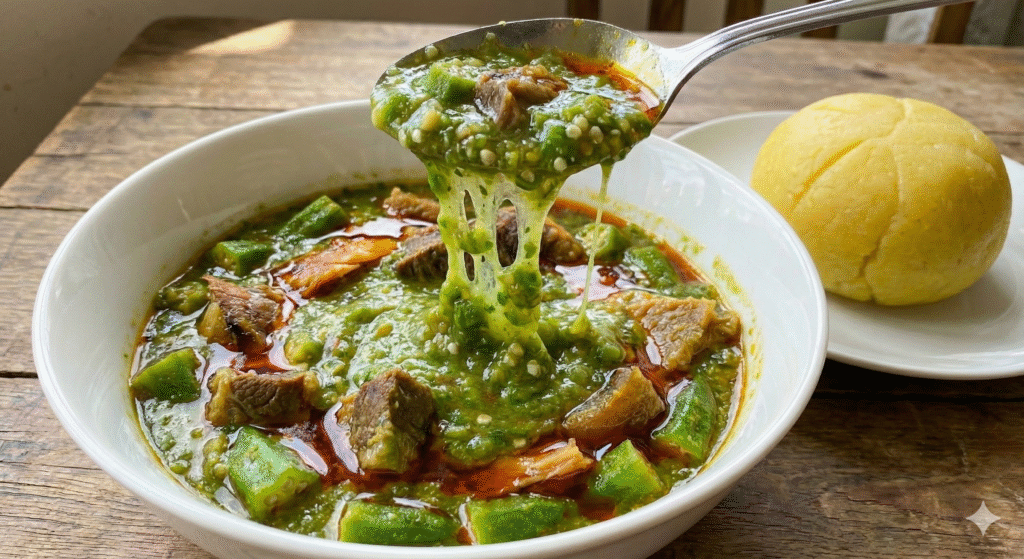
Okro Soup (Okra) is one of the most popular “Draw Soups” in Nigeria. It is a mucilaginous, savory stew typically cooked with palm oil, fish, and meats. Unlike “Plain Okra” (which is served with a separate stew), Ofe Okro or Ila Alasepo is a one-pot dish where the soup and stew bases are married together. It is best served with Eba, Semovita, or Pounded Yam. The flavor profile is fresh, earthy, and umami-rich, defined by the fermentation of locust beans (Iru) and the sweetness of the vegetable. It is extremely stomach friendly, and I eat it every day to stay regular.
The Strategy for Success
The Goal (The Promise):
This guide ensures you get an Okro soup that is vibrant green (not brown) and retains its elasticity (“draw”). The okra pieces should have a slight crunch, not be mushy.
The Common Pitfall (The Risk):
The “Watery Brown Soup.” This happens when the cook covers the pot (trapping heat and acid) or overcooks the vegetable, causing the mucilage to break down and the chlorophyll to degrade into pheophytin (brown color).
The Method (The Teacher):
We will use the “Flash-Simmer” Technique. We build a concentrated, flavorful stock base first and introduce the okra only in the final 5 minutes of cooking. We also control the cutting method to maximize surface area for the best “draw.”
At a Glance
| Prep | Cook | Total | Servings | Skill Level |
| 20 Min | 25 Min | 45 Min | 4-6 | Beginner |
Why This Recipe Works
- Surface Area Activation: By chopping the okra into medium chunks rather than blending it smooth, we release mucilage while retaining texture.
- Open-Lid Cooking: We cook the vegetable with the lid OFF. This allows volatile organic acids to escape with the steam, preventing them from turning the green okra brown.
- Base Reduction: We reduce the meat stock significantly before adding the vegetable. Okra releases water as it cooks; if your base is too watery, you end up with “tea” instead of soup.
The Ingredients (Teacher’s Notes)
- 500g Fresh Okra (Fingers)
- 💡 (The Teacher’s ‘Why’): Okra contains mucilage, a slimy substance made of sugar residues (exopolysaccharides) and proteins. This is what helps the “swallow” slide down your throat.
- 🚫 (The Risk Manager’s ‘Why Not’): The Snap Test is Mandatory. Before buying, snap the tip of an okra finger. If it snaps cleanly, it is fresh. If it bends or is rubbery, it is woody and fibrous. Do not buy it. It will be inedible.
- 1/2 Cup Red Palm Oil
- 💡 (The Teacher’s ‘Why’): Provides the lipid base for flavor carriage and the signature orange-red contrast to the green vegetable.
- 🚫 (The Risk Manager’s ‘Why Not’): Do not use vegetable oil. The flavor profile will be completely wrong.
- 2 tbsp Locust Beans (Iru) (Rinsed)
- 💡 (The Teacher’s ‘Why’): This is the Nigerian truffle. It provides a pungent, fermented umami depth that Maggi cubes cannot replicate.
- 🚫 (The Risk Manager’s ‘Why Not’): Do not use “dried” Iru without soaking it first, or it will be hard like pebbles in the soup.
- Proteins: Assorted Meat (Beef, Shaki/Tripe) & Smoked Fish (Catfish or Mackerel)
- 💡 (The Teacher’s ‘Why’): Smoked fish is crucial. It infuses the water with a smoky flavor that permeates the vegetable.
- 🚫 (The Risk Manager’s ‘Why Not’): Do not leave bones in the smoked fish. Okra is a “swallow” soup; you don’t want to choke on a sharp bone while swallowing.
- 3 tbsp Ground Crayfish
- 💡 (The Teacher’s ‘Why’): Adds savory depth (glutamates).
- 🚫 (The Risk Manager’s ‘Why Not’): Do not use whole crayfish; the texture is unpleasant in the soft soup.
- 1 tsp Potash (Kaun) – OPTIONAL
- 💡 (The Teacher’s ‘Why’): An alkaline salt that breaks down cell walls, creating extreme draw/elasticity.
- 🚫 (The Risk Manager’s ‘Why Not’): Proceed with Caution. Potash destroys nutrients (specifically Vitamin C) and can impart a soapy taste if overused. This recipe works without it if your okra is fresh.
Instructions (The ‘Why/Why Not’ Core)
Step 1: The “Mucilage Cut” (Prep)
Wash the okra thoroughly. Slice off the head and tail. Chop 80% of the okra into medium rounds (knife cut). Roughly blend or grate the remaining 20%.
* 💡 (The Teacher’s ‘Why’): We mix techniques. The knife-cut pieces provide the crunch (texture), while the grated/blended portion releases the maximum slime (viscosity) to thicken the soup.
* 🚫 (The Risk Manager’s ‘Why Not’): Do not blend all of it into a smoothie unless you are feeding a baby. Adult Okra soup needs texture.
Step 2: The Flavor Concentrate (The Base)
Boil your tough meats (Beef, Shaki) with onions, seasoning cubes, and salt until tender. Once cooked, let the water reduce until you have about 1-2 cups of concentrated, rich stock remaining. Add the smoked fish and allow to simmer for 5 minutes.
* 💡 (The Teacher’s ‘Why’): We need a small amount of very potent liquid. Okra releases water. If you start with a pot full of water, your soup will be watery.
* 🚫 (The Risk Manager’s ‘Why Not’): Do not add the okra yet! The meat must be 100% cooked before the vegetable goes in.
Step 3: The Seasoning Bloom
Add the Palm Oil, Ground Crayfish, Scotch Bonnet (chopped), and Iru to the boiling stock. Let it cook for 5-7 minutes.
* 💡 (The Teacher’s ‘Why’): We are cooking the raw edge out of the palm oil and allowing the peppers to soften.
* 🚫 (The Risk Manager’s ‘Why Not’): Do not cover the pot fully from this point on. We want evaporation.
Step 4: The Okra Drop (Critical Step)
Stir the boiling base. Add the prepared Okra. Stir gently to combine. Lower the heat to medium. DO NOT COVER THE POT.
* 💡 (The Teacher’s ‘Why’): Leaving the lid off prevents the “greenhouse effect.” Trapping steam raises the temperature too high and keeps acidic vapors inside, which turns the chlorophyll (green) to pheophytin (olive/brown).
* 🚫 (The Risk Manager’s ‘Why Not’): Do not walk away. Okra bubbles up and can boil over in seconds.
Step 5: The “Flash” Finish
Simmer the okra for exactly 3-5 minutes. It should be bright green and bubbly. If adding leafy greens (Spinach/Ugu), add them now, stir, count to 60, and turn off the heat.
* 💡 (The Teacher’s ‘Why’): Residual heat will finish cooking the greens.
* 🚫 (The Risk Manager’s ‘Why Not’): Do not overcook! If the okra becomes too soft, the mucilage structure breaks down, and you lose the “draw.”
The ‘Risk-Free Q&A’ (Troubleshooting)
- Scenario 1: “My soup is not ‘drawing’ (not slimy).”
- Analysis: You used old/woody okra, or you fried the okra in oil first (which seals the mucilage).
- Solution: You can grate 2-3 extra fresh okra pods and stir them in at the very end (off the heat) to introduce fresh slime.
- Scenario 2: “The soup turned brown.”
- Analysis: You covered the pot after adding the okra, or you cooked it for 15+ minutes.
- Solution: It is still edible, but the fresh taste is diminished. Next time, keep the lid off and set a timer.
- Scenario 3: “It is too watery.”
- Analysis: You started with too much meat stock in Step 2.
- Solution: Leave the pot open on high heat to evaporate moisture rapidly. Do not add flour or cornstarch—that is not Nigerian style. You can add more Crayfish to thicken it slightly.
Notes & Substitutions
- Vegetarian: Skip the meat/fish. Use a rich mushroom stock and plenty of Iru and Crayfish for umami.
- Ogbono-Okra: Many people mix Ogbono and Okra. If doing this, cook the Ogbono first (for 20 mins), then add Okra at the very end.
- Baking Soda: A tiny pinch helps retain green color, but be careful—it can give a soapy aftertaste and destroy vitamins.
Make-Ahead & Storage
- Fridge: Stays fresh for 2-3 days.
- Freezer: Okra freezes well. The texture might change slightly (less crunch), but the flavor remains.
- Reheating: Reheat on the stove, not the microwave. The microwave creates hot spots that can break the emulsion.
The “Best” Okro Soup Recipe Card
Ingredients:
- 500g Fresh Okra (Chopped/Grated mix)
- 1/2 cup Palm Oil
- Assorted Meats (Beef, Shaki) & Smoked Fish
- 2 tbsp Locust Beans (Iru)
- 3 tbsp Ground Crayfish
- 2 Scotch Bonnet Peppers (Chopped)
- 1 Seasoning Cube
- Salt to taste
- Handful of Spinach or Ugu (optional)
Instructions:
- Prep: Wash and chop okra (80% chopped, 20% grated).
- Stock: Boil meats until tender. Reduce stock to approx 1 cup. Add smoked fish.
- Base: Add palm oil, peppers, iru, and crayfish to the stock. Boil for 5-7 mins.
- Okra: Add the okra. Do not cover. Simmer for 3-5 mins max.
- Finish: Stir in leafy greens. Simmer 1 min. Remove from heat immediately. Serve with Fufu or Eba.