
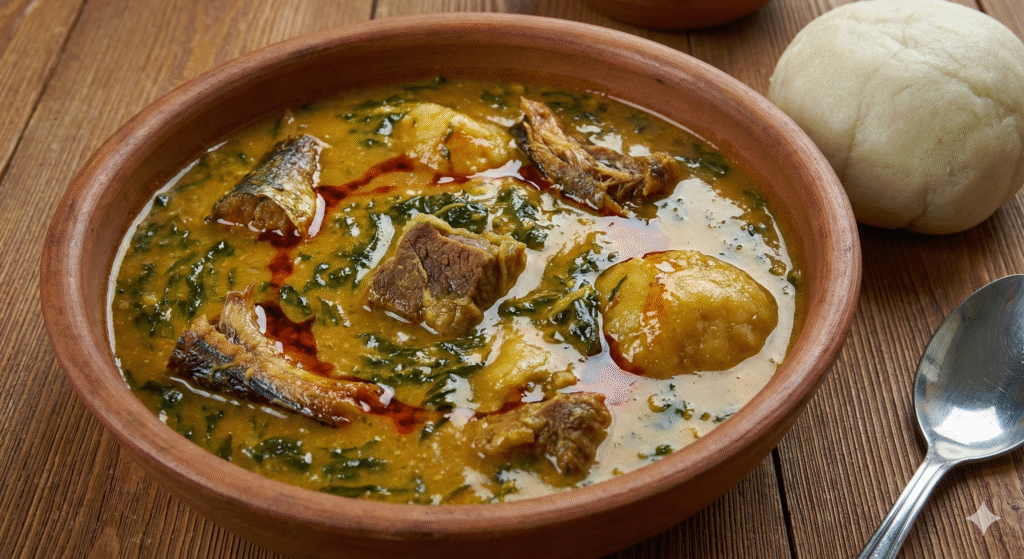
Intro
Ofe Oha is a definitive soup of the Igbo people of Eastern Nigeria. Unlike the melon-seed based Egusi or the slime-based Okra, Oha is a “thickened stock” soup. It relies on a silky, creamy base made from pounded Cocoyam (Ede) to suspend the tender Oha leaves. Best served with Fufu or Pounded Yam, the flavor profile is a sophisticated balance of savory stock, the pungent umami of Ogiri Igbo, and the distinct floral aroma of the Oha leaf itself. I like to add Uziza leaves for that extra aromatic peppery punch. My daughter hates to eat ‘swallow’ meals, but with Oha soup she can eat swallows every day.
The Strategy for Success
The Goal (The Promise):
This guide ensures you achieve a soup with a silky, uniform consistency (no lumps) where the Oha leaves remain vibrant green and tender, rather than turning black or tough.
The Common Pitfall (The Risk):
The “Black Leaf” Disaster. Oha leaves are highly sensitive to metal. Cutting them with a knife causes rapid oxidative browning, turning your beautiful soup dark and unappealing. Another failure point is a watery soup caused by using the wrong type of Cocoyam.
The Method (The Teacher):
We will use the “Hand-Torn” Technique for the vegetables to prevent oxidation. For the thickener, we will use the “Hot Emulsion” Method, ensuring the cocoyam is pounded while piping hot and dissolved completely into the stock to create a velvety texture.
At a Glance
| Prep | Cook | Total | Servings | Skill Level |
| 40 Min | 45 Min | 1 Hr 25 Min | 6 | Intermediate |
Why This Recipe Works
- Enzymatic Prevention: By tearing the leaves by hand instead of slicing, we disrupt fewer cells and avoid the reaction between the steel blade and the leaf’s phenols, preserving the green color.
- Starch Gelatinization: Pounding the cocoyam while hot releases the amylopectin (starch) effectively. When added to the hot stock, this starch swells and binds the water and oil into a stable, creamy emulsion.
- Flavor Layering: We use Ogiri Igbo (fermented castor seeds). Its potent aroma mellows out during cooking into a deep, savory richness that bouillon cubes alone cannot replicate.
The Ingredients (Teacher’s Notes)
- 1 Bunch Fresh Oha Leaves
- 💡 (The Teacher’s ‘Why’): This is the star. It has a delicate texture and a unique flavor that cannot be substituted with Spinach.
- 🚫 (The Risk Manager’s ‘Why Not’): Do not use a knife. Put the knife away. You must tear these leaves with your fingers. Also, discard the woody stems; only use the soft leaves.
- 8-10 Small Cocoyams (Ede Ofe)
- 💡 (The Teacher’s ‘Why’): You specifically need the “Soup Cocoyam” (Colocasia esculenta), which is soft and pinkish/white when boiled. It acts as the thickener.
- 🚫 (The Risk Manager’s ‘Why Not’): Do not buy “Ede Buka” (the type meant for eating/boiling with palm oil). That variety is too firm and will result in lumpy, hard chunks instead of a smooth paste.
- 1 Wrap Ogiri Igbo
- 💡 (The Teacher’s ‘Why’): This provides the authentic traditional taste. It smells very strong (like pungent cheese) raw, but transforms the dish when cooked.
- 🚫 (The Risk Manager’s ‘Why Not’): Do not omit this. Without Ogiri, you are just making vegetable stew, not Ofe Oha.
- Palm Oil (approx 1 cup)
- 💡 (The Teacher’s ‘Why’): Provides the color and carries the fat-soluble vitamins.
- 🚫 (The Risk Manager’s ‘Why Not’): Do not bleach the oil. We want the raw, nutty flavor and the bright orange color.
- Small bunch Uziza Leaves (Optional but recommended)
- 💡 (The Teacher’s ‘Why’): Adds a peppery, aromatic heat that complements the mild Oha.
- 🚫 (The Risk Manager’s ‘Why Not’): Do not use too much, or it will overpower the delicate Oha flavor.
- Proteins: Beef, Shaki (Tripe), Stockfish, Dry Fish
- 💡 (The Teacher’s ‘Why’): Stockfish adds a depth of flavor that is non-negotiable in Igbo soups.
Instructions (The ‘Why/Why Not’ Core)
Step 1: The Cocoyam Prep (The Thickener)
Wash the cocoyams (do not peel yet). Boil them in plenty of water until soft (approx 15-20 mins). Peel them while hot. Pound them immediately in a mortar or blend with a food processor until you have a smooth, elastic paste.
- 💡 (The Teacher’s ‘Why’): Heat keeps the starch pliable. If they cool down, they undergo “retrogradation” (hardening) and will form lumps that never dissolve.
- 🚫 (The Risk Manager’s ‘Why Not’): Do not add water while pounding unless absolutely necessary. You want a thick, sticky dough, not a liquid batter.
Step 2: The Foundation Stock
Boil your meats, stockfish, and dry fish with onions, seasoning cubes, and salt. Cook until tender. You want about 3-4 cups of rich, concentrated stock remaining.
- 💡 (The Teacher’s ‘Why’): The flavor of the soup comes from this stock. A weak stock equals a weak soup.
- 🚫 (The Risk Manager’s ‘Why Not’): Do not have too much water. It is easier to add water later than to reduce a watery soup once the thickener is added.
Step 3: The Base Construction
To the boiling meat stock, add the Palm Oil, Ground Crayfish, pepper (yellow habanero/scotch bonnet), and the Ogiri Igbo. Let this boil for 5 minutes to marry the flavors.
- 💡 (The Teacher’s ‘Why’): We cook the oil and Ogiri before thickening to ensure the raw taste is cooked off.
- 🚫 (The Risk Manager’s ‘Why Not’): Do not stir vigorously if your fish is fragile. Shake the pot instead to prevent breaking the fish.
Step 4: The Emulsion (Thickening)
Scoop small balls of the pounded cocoyam paste into the boiling pot. Cover and let it cook on high heat.
- 💡 (The Teacher’s ‘Why’): The lumps need high heat to dissolve into the soup. As they melt, they thicken the liquid.
- 🚫 (The Risk Manager’s ‘Why Not’): Do not stir immediately. If you stir now, the lumps will break into tiny grainy particles. Let them dissolve naturally for about 5-8 minutes.
Step 5: The “Hand-Torn” Finish
Once the cocoyam has dissolved and the soup is thick and creamy, add the chopped Uziza leaves (if using). Cook for 1 minute. Finally, add the hand-torn Oha leaves. Stir gently. Simmer for 2 minutes maximum. Turn off the heat.
- 💡 (The Teacher’s ‘Why’): Oha leaves are delicate. They need very little heat to soften. Residual heat is often enough.
- 🚫 (The Risk Manager’s ‘Why Not’): Do not overcook! If you leave it on the fire too long, the leaves turn dark and the soup loses its freshness.
The ‘Risk-Free Q&A’ (Troubleshooting)
- Scenario 1: “The Cocoyam lumps won’t dissolve!”
- Analysis: You likely used the “Eating” type of cocoyam (Ede Buka) or pounded them when they were cold.
- Solution: Use a cooking spoon to fish out the lumps and press them against the side of the pot to mash them, or remove them and use a little flour (Achi) dissolved in water to save the texture.
- Scenario 2: “My soup is too thick/solid.”
- Analysis: The cocoyam was very starchy, or the water reduced too much.
- Solution: Add hot water (never cold) in small increments until you reach the desired consistency.
- Scenario 3: “The Oha leaves turned black.”
- Analysis: You used a knife to cut them, or you covered the pot after adding the leaves.
- Solution: Next time, hand-tear only. And leave the pot lid off for the final few minutes to let acidic steam escape.
Notes & Substitutions
- Alternative Thickeners: If you cannot find Cocoyam, you can use Achi or Ofor (soup thickeners sold in markets). They have a slightly slimier texture but work well. Using pureed potato or yam is a last resort but changes the taste.
- Ogiri Substitute: If you absolutely cannot find Ogiri Igbo, use Iru (Locust beans), though the flavor profile will shift slightly towards Yoruba style cooking.
Make-Ahead & Storage
- Fridge: Stores well for 3 days. The soup will become much thicker in the fridge (starch solidifies).
- Reheating: You must add a splash of water when reheating, as the cocoyam paste will have set into a jelly-like state.
- Freezing: Freezes well.
The “Best” Oha Soup Recipe Card
Ingredients:
- 1 bunch Oha Leaves (Hand-torn)
- 8-10 Small Soup Cocoyams (Ede Ofe)
- Assorted Meats (Beef, Shaki) & Stockfish
- 1 cup Palm Oil
- 1 wrap Ogiri Igbo
- 3 tbsp Ground Crayfish
- Yellow Pepper (Scotch Bonnet)
- Small handful Uziza leaves (sliced)
- Salt & Seasoning Cubes
Instructions:
- Thickener: Boil cocoyam until soft. Peel and pound into a smooth paste while hot.
- Stock: Boil meats and stockfish until tender.
- Base: Add palm oil, pepper, crayfish, and Ogiri to the stock. Boil for 5 mins.
- Emulsify: Add lumps of cocoyam paste. Cover and cook until lumps dissolve and soup thickens.
- Finish: Add Uziza leaves (cook 1 min). Add hand-torn Oha leaves. Simmer 2 mins. Serve hot.