
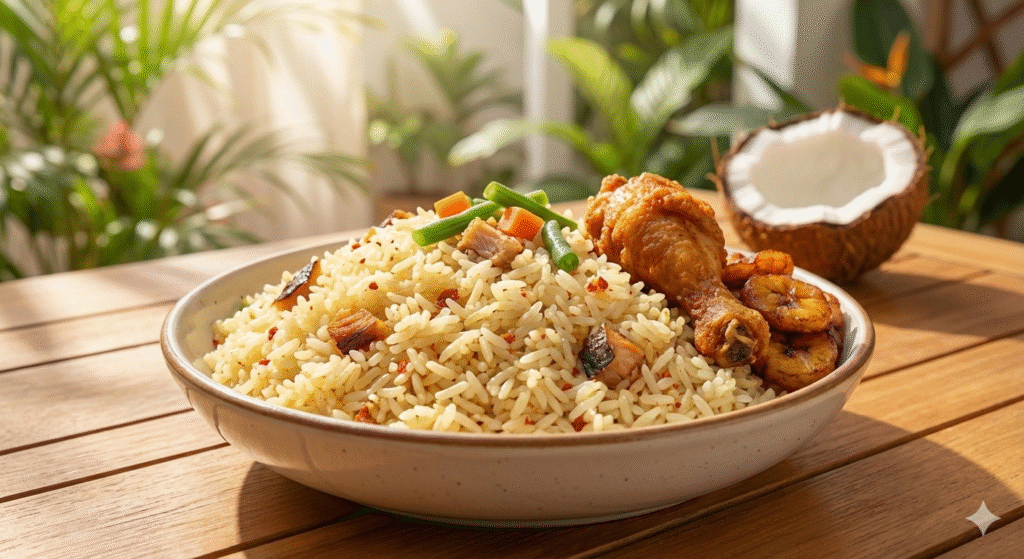
1. Nigerian Coconut Rice: The “Fat-First” Absorption Method
2. Intro
Authentic Nigerian Coconut Rice is a far cry from the sweet, sticky rice desserts found in Asian cuisine. This is a savory, spicy, and deeply aromatic main course, hailing from the coastal regions of Southern Nigeria. It balances the natural creaminess of coconut milk with the heat of scotch bonnet peppers and the umami of ground crayfish. It is a “special occasion” dish, often served at weddings or Sunday lunches when you want to impress.
3. Section: “The Strategy for Success”
- The Goal (The Promise): We want individual, separate grains of rice that are infused with coconut flavor to the very core, without being greasy. The color should be a pale, creamy yellow-brown, and the aroma should fill the house.
- The Common Pitfall (The Risk): The two enemies of Coconut Rice are “The Mush” (soggy, gluey texture) and “The Burn” (coconut milk contains sugars and fats that scorch easily). Many cooks end up with rice that is raw on top and burnt black on the bottom.
- The Method (The Teacher): We will use the “Toast & Steam” Technique. Instead of boiling rice directly in liquid, we will toast the washed rice in a flavored oil base first to “seal” the starch. Then, we cook with a precise ratio of coconut milk and use trapped steam (foil method) to finish the cooking, preventing the bottom from scorching.
4. Table: “At a Glance”
| Prep | Cook | Total | Servings | Skill Level |
| 30 Mins | 45 Mins | 1 Hr 15 Mins | 4-6 | Intermediate |
5. Section: “Why This Recipe Works”
- Lipid Coating: By toasting the rice in the coconut oil/sauce base before adding the bulk liquid, we coat each grain in fat. This creates a barrier that prevents the rice from releasing excess surface starch, stopping it from becoming sticky.
- Controlled Evaporation: Coconut milk is denser than water. If you boil it vigorously like plain white rice, the water evaporates too fast, leaving thick fat that burns. Our low-heat steam method cooks the rice gently.
- Umami Synergy: The sweetness of the coconut needs a counterbalance. The inclusion of dried crayfish and smoked fish provides the necessary savory “base” that prevents the dish from tasting like a dessert.
6. Section: “The Ingredients (Teacher’s Notes)”
- Long Grain Parboiled Rice: 3 Cups.
- 💡 (The Teacher’s ‘Why’): Parboiled rice has a firmer structure. It can withstand the heavy, fatty cooking liquid without disintegrating.
- 🚫 (The Risk Manager’s ‘Why Not’): Do not use Basmati or Jasmine rice for this specific Nigerian method. They are too soft and will turn into a mashed pudding under the weight of the coconut milk.
- Coconut Milk (Ideally Fresh): 1 Liter (approx. 2 large coconuts or 2.5 cans).
- 💡 (The Teacher’s ‘Why’): Freshly extracted milk has a natural sweetness and oil content that canned versions lack.
- 🚫 (The Risk Manager’s ‘Why Not’): If using canned, do not buy “Coconut Cream” (too thick) or “Coconut Water” (too thin). Buy “Full Fat Coconut Milk.” Shake the can well before opening.
- Ground Crayfish: 3 Tablespoons.
- 💡 (The Teacher’s ‘Why’): This is the flavor bridge. It connects the sweet coconut to the savory peppers.
- 🚫 (The Risk Manager’s ‘Why Not’): Do not skip this unless you have a shellfish allergy. Without it, the rice tastes flat and one-dimensional.
- Scotch Bonnet Peppers (Rodo): 3-4 (Yellow is preferred for color).
- 💡 (The Teacher’s ‘Why’): We need heat to cut through the richness of the coconut fat.
- Smoked Fish / Dried Prawns: 1 cup (Cleaned and de-boned).
- 💡 (The Teacher’s ‘Why’): Adds a smoky depth that mimics the firewood cooking of the village.
7. Section: “Instructions (The ‘Why/Why Not’ Core)”
Phase 1: The Rice Prep
The Step: Wash the rice repeatedly (5-6 times) with warm water until the water runs perfectly clear. Drain in a colander for 10 minutes.
- 💡 (The Teacher’s ‘Why’): We need to remove all free starch. Coconut milk is already thick; any extra starch will make the dish gummy.
- 🚫 (The Risk Manager’s ‘Why Not’): Do not soak the rice. Just wash and drain. Soaking makes the grain too porous for this recipe.
Phase 2: The Flavor Base
The Step: In a heavy-bottomed pot, heat a splash of vegetable oil or coconut oil. Sauté chopped onions, minced garlic/ginger, and the scotch bonnet peppers until fragrant. Add the smoked fish and crayfish.
- 💡 (The Teacher’s ‘Why’): We are building an aromatic foundation. Frying the crayfish releases its oils early.
- 🚫 (The Risk Manager’s ‘Why Not’): Watch the heat. Crayfish burns in seconds and tastes bitter. Keep it moving.
Phase 3: The Toast (Crucial Step)
The Step: Pour the drained (dry) rice into the pot with the fried base. Stir-fry the raw rice for 3-5 minutes. The grains should turn slightly translucent and look glossy.
- 💡 (The Teacher’s ‘Why’): This is “pilaf style.” We are gelatinizing the outer layer of the rice and coating it in flavored oil. This ensures the grains stay separate later.
- 🚫 (The Risk Manager’s ‘Why Not’): Do not skip this. If you pour milk onto raw, cold rice, you increase the risk of clumping.
Phase 4: The Absorption
The Step: Pour in the Coconut Milk. The liquid level should be exactly the same level as the rice (or barely 1cm above). Add stock cubes and salt. Stir ONCE to combine. Bring to a boil.
- 💡 (The Teacher’s ‘Why’): Coconut milk foams when boiled. We bring it to a boil to activate the heat, then we must immediately drop the temperature.
- 🚫 (The Risk Manager’s ‘Why Not’): Do not drown the rice. Coconut rice does not need as much liquid as Jollof because the rice doesn’t absorb oil as fast as water. Less liquid is safer; you can always add water, but you can’t take it out.
Phase 5: The Steam Finish
The Step: Once it boils, cover the pot with foil or a plastic bag, then place the lid on tightly. Turn the heat down to the lowest possible setting. Cook for 30 minutes undisturbed.
- 💡 (The Teacher’s ‘Why’): We are trapping steam to cook the top layer while the low heat protects the bottom layer.
- 🚫 (The Risk Manager’s ‘Why Not’): DO NOT OPEN THE LID. Every time you check, steam escapes, and the rice dries out unevenly. Trust the timer.
8. Section: “The ‘Risk-Free Q&A’ (Troubleshooting)”
- Analysis 1: “The rice is hard, but the liquid is dried up.”
- The Diagnosis: Your heat was too high, causing evaporation before the rice could absorb the moisture.
- The Solution: Do not stir! Puncture small holes in the rice with the handle of a spoon. Pour 1/4 cup of hot water (or stock) into the holes. Cover immediately and steam for another 10 minutes on low.
- Analysis 2: “It’s mushy and looks like porridge.”
- The Diagnosis: You didn’t wash the rice enough, or you used too much liquid.
- The Solution: Remove the lid. Turn off the heat. Place a kitchen towel over the pot (without the lid) to absorb excess steam. Let it sit for 20 minutes. Fluff with a fork.
- Analysis 3: “The bottom is burnt black.”
- The Diagnosis: The sugar in the coconut milk caramelized too fast.
- The Solution: Do not scrape the bottom! Carefully scoop the good rice from the top into a new serving dish. Leave the burnt layer in the pot. If the burnt smell is strong, cover the good rice with a slice of white bread for 5 minutes to absorb the smoky aroma.
9. Section: Notes & Substitutions
- Protein: You can add boiled beef or fried chicken to the pot in Phase 4, but traditionalists prefer serving the meat on the side to keep the white/cream aesthetic of the rice.
- Vegetables: If adding carrots or green beans for color, steam them separately and fold them in at the very end. If you cook them with the rice, they will turn a dull, muddy color.
10. Section: Make-Ahead & Storage
- Spoilage Risk: Coconut milk spoils very fast, even in the fridge.
- Storage: Store in an airtight container in the fridge for maximum 2 days.
- Reheating: It creates a lot of oil when reheated. Microwave is best.
11. Section: The “Best” Coconut Rice Recipe Card
Ingredients:
- 3 cups Long Grain Parboiled Rice
- 1 Liter Coconut Milk (Full Fat)
- 3 tbsp Ground Crayfish
- 1 cup Smoked Fish / Dried Prawns
- 1 Onion (Chopped)
- 3 Scotch Bonnet Peppers (Minced)
- Stock cubes & Salt to taste
Instructions:
- Wash: Rinse rice thoroughly until water is clear. Drain well.
- Base: Sauté onions, peppers, crayfish, and smoked fish in a little oil.
- Toast: Add the drained rice to the pot. Stir-fry for 3-5 mins until glossy.
- Liquid: Pour in coconut milk (level with rice). Season. Bring to a boil.
- Steam: Cover with foil and lid. Reduce heat to Minimum. Cook for 30 mins.
- Finish: Turn off heat. Let sit for 10 mins. Fluff and serve.