
Welcome to your new favorite section! Cooking Nigerian food is an experience, and having the right tools or kitchen essentials can make that experience so much smoother, faster, and more fun.
While our ancestors created masterpieces with just a few pots and a firewood hearth, a modern kitchen with a few key pieces of equipment will help you get that perfect, smooth stew, that fluffy Eba, and that “bottom-pot” Jollof without the stress.
You don’t need to buy everything at once! This list is a guide to the workhorses of the Nigerian kitchen. We’ll start with the absolute non-negotiables and move to the tools that make life just a little bit easier.
A Quick Note: This page contains affiliate links. This means if you click a link and make a purchase, I may receive a small commission at no extra cost to you. This helps support the website and allows me to keep creating free, delicious recipes for you. I only recommend products I personally use and truly believe in!
The Non-Negotiables: Start Here
These are the items you will use almost every single time you cook a Nigerian meal.
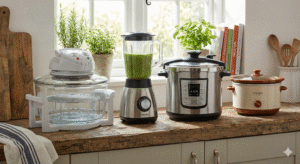
1. The Power Blender
This is, without a doubt, the #1 most important tool in a modern Nigerian kitchen. It’s the heart of our cooking. You need it to create the smooth pepper base (Obe Ata) for stews, Jollof rice, and soups. A weak blender will give you a chunky, pale base. A powerful one gives you that silky-smooth, vibrant red purée.
- Why you need it: Blending tomatoes, red bell peppers (tatashe), onions, and scotch bonnets (ata rodo).
- My Recommendations:
- [Link: My Top-Choice High-Speed Blender (The “Splurge” Option)] – An investment, but it will pulverize anything and last a lifetime.- https://amzn.to/4rwJMPp]
- [Link: The Best “Workhorse” Mid-Range Blender] – A fantastic, reliable option that gets the job done beautifully.-https://amzn.to/4b8IB2Q]
2. A Heavy-Bottomed Pot (with a tight lid!)
Forget thin, flimsy pots. To make great Jollof Rice, you need a pot that holds heat evenly and won’t scorch the rice in two minutes. This is where enameled cast iron (like a Dutch oven) or a good-quality stainless steel pot with a thick base comes in. The tight-fitting lid is crucial for trapping steam to cook the Jollof perfectly.
- Why you need it: Making Jollof Rice, stews, and soups.
- My Recommendations:
- [Link: The Enameled Cast Iron Pot I Use for Jollof – https://amzn.to/3N2DZ58]
- [Link: A very affordable option – https://amzn.to/40yukX3]
3. The “Swallow” Turner (Omo Orogun)
If you plan to make any swallow—Eba (Garri), Amala, Pounded Yam (from flour), or Semo—a regular spoon won’t work. You’ll either break the spoon or end up with a lumpy, frustrating mess. You need a dedicated, long, and very sturdy wooden turning stick to “turn” the swallow against the side of the pot and get that smooth, elastic texture.
- Why you need it: Making Eba, Amala, Semo, and Poundo.
- My Recommendations:
- [Link: Get the Classic Wooden Turning Stick (Omo Orogun- https://amzn.to/3MsvCjh]
- [Link: A Modern Silicone-Tipped, Sturdy Alternative – https://amzn.to/4axaIbS]
The “Must-Haves” for Regular Cooking
You’ll be reaching for these items daily.
4. A Good Set of Knives & Cutting Board
You’ll be doing a lot of chopping. Onions, peppers, vegetables, meat, and fish. A sharp chef’s knife and a sturdy cutting board are your best friends.
- My Recommendations:
- [Link: My Favourite All-Purpose Chef’s Knife – https://amzn.to/3MOjM30 ]
- [Link: Durable, Easy-to-Clean Cutting Board Set – https://amzn.to/4aO2afp]
5. A Good Frying Pan
How else will you fry your dodo (plantains), chicken, fish, and beef for the stew? A good non-stick or cast-iron skillet is essential.
- My Recommendations:
- [Link: The Non-Stick Skillet I Use Every Day – https://amzn.to/4qSxRKE ]
- [Link: A Pre-Seasoned Cast Iron Skillet (for an amazing crust!)- https://amzn.to/3MqilYw]
6. Wooden Spoons & Cooking Utensils
You need spoons and spatulas that won’t scratch your non-stick pans or react with your tomato stew. Wooden spoons are the traditional choice and are perfect for stirring.
- My Recommendations:
- [Link: My Go-To Wooden Utensil Set – https://amzn.to/4tUPyvT ]
- [Link: Heat-Resistant Silicone Spatula (Great for scraping the blender!) – https://amzn.to/4ayMazc ]
7. Sieves & Strainers
You’ll need these for washing your rice (a must for Jollof!), sifting flour, and straining pap (akamu). A set with multiple sizes is incredibly useful.
- My Recommendations:
- [Link: A Versatile Fine-Mesh Strainer Set – https://amzn.to/4b4qUBz ]
“Nice-to-Haves” That Make Life Easier
Once you have the basics, these tools will level up your cooking game.
8. A Pressure Cooker
This is a game-changer for Nigerian cooking. We use a lot of tougher cuts of meat (like goat, oxtail, and beef) and cook with a lot of beans. A pressure cooker (like an Instant Pot) can cut your cooking time for meat from 1.5 hours to 25 minutes.
- Why you need it: Tenderizing meats, cooking beans (Ewa Agoyin), and making pepper soup.
- My Recommendations:
- [Link: The Instant Pot/Pressure Cooker I Recommend- https://amzn.to/4kTkqIU]
9. Dry Mill / Spice Grinder
This is often an attachment that comes with a blender. It’s used for grinding dry ingredients into powder, like crayfish, egusi (melon seeds), ogbono, and whole spices. It’s the secret to unlocking those deep, traditional flavors.
- Why you need it: Grinding crayfish, spices, and egusi.
- My Recommendations:
- [Link: My Favourite Blender (it comes with a dry mill)- https://amzn.to/4qTBgZA ]
- [Link: A Small, Stand-Alone Coffee/Spice Grinder – https://amzn.to/3N2CJz1 ]
10. Mortar & Pestle
The original food processor! While a blender is faster, a mortar and pestle is still the best way to grind peppers for a small-batch, textured stew (like Ofada) or to pound spices. It releases oils and flavors in a way a blender can’t.
- My Recommendations:
- [Link: A Beautiful, Traditional Stone Mortar & Pestle – https://amzn.to/4s8E6uO]
- [Link: A Smaller, Wooden One (Great for spices) – https://amzn.to/4cIR0LB]
11. Moi Moi Cookware
Moi Moi (steamed bean pudding) is traditionally cooked in special “Uma” leaves. If you can’t find those, you need something to steam it in.
- My Recommendations:
- [Link: Moi Moi Cooking Pouch (Pack of 100) Multi-purpose, (Disposable & Easy) – https://amzn.to/4qZ4oim ]
- [Link: Silicone Steaming Cups – https://amzn.to/4aKGTTX ]